
Table of Contents
Do you have the right Qigong teacher?
Where is the Qi moving? Do you not know where it should be moving? Have you not been taught this? Do you have the right Qigong teacher?
There is a huge misconception about Qigong, about what Qigong is. Unfortunately, most people who are practicing what they think is Qigong are actually practicing a physical exercise. The emphasis needs to be on the Qi.
Practising physically, with the slow rhythmic movements and the relaxation added to the deep breathing, the abdominal breathing, are beneficial to your health and your well-being. But it doesn’t make these exercises Qigong. When you are practicing at this level, you’re not doing Qigong. You are moving physically, not energetically, not internally.
Imagining that you’re moving Qi does not mean that you’re moving Qi. Imagining colours, or moving Qi, or stagnant Qi away from your heart, etc. doesn’t mean that you’re doing so. To practice Qigong you need to use all of the tools of Qigong. Using them efficiently and effectively.
The tools that we use and Qigong are the stances, the postures, the breathing, the vision, slight tensions, slight stretches, the Yi (the brain) and, finally, the Shen (That’s the consciousness).
All of these tools are used in active Qigong. That is where there is movement of the body to help guide the movement of the Qi. However, when practicing passive Qigong there is no physical movement and there are only two tools used. That is the Yi and the Shen.
Let’s have a look at some of these tools. The stances, the postures, the stretches, the breathing, the vision and any tensions are all governed by the brain. The brain controls all of these. The Yi guides all of these movements, all of these stretches, all of the positions. It also guides the Qi. By doing these exercises in this way, by using all of these tools, it helps the Yi, helps you as a practitioner to focus on what you’re doing. And start to move the Qi. Gradually, we can cut back the number of these tools. We can spend less time working with them and more time with the Yi alone.
The last of the tools is the Shen. This is our consciousness and we use the consciousness to be passively aware of the movement of the Qi. This is impossible if our body and our mind are noisy. That is why we should always start our Qigong journey by practicing active Qigong. By getting the stances and postures correct so that the body can become quiet. Then the mind can become quiet. Once we have attained good posture we can have a quiet body and a quiet mind. Then that whisper of the movement of the Qi can become much more apparent and, once we are aware of that movement, we can use that feedback to assist our guidance of it.
I’m often asked about why the same Qigong looks different between schools, between teachers, in the ways taught and where the emphasis is. There are a couple of reasons for this. The first reason, which is a valid reason, is that over the millennia the Masters have explored these Qigong and developed them further. They have discovered that these Qigong, these movements with a slightly different focus, can be used to work with different meridians. The other reason, which is not valid, is that the people teaching do not understand what they are teaching. They have got no idea about what’s moving, where it’s moving, why is moving, and what the effects are.
A True Qigong teacher explores
A classic example of this development as Masters (my Qigong teacher was a true Master) investigated different Qigong can be seen in the Silk Exercises that developed into the Ba Duan Jin and also the Ten Fundamental Treasures. There are four sets of Silk Exercises with the same names, or very similar names, to those used in the Ba Duan Jin and in the Ten Fundamental Treasures but each of the sets uses the Qi and a different way. It guides Qi in a different way, even though the exercises have similar names and even though the movements look similar. The external movements look similar, the internal are completely different. Developments such as this can also be seen in exercises such as the Change the Sinews exercise from the Ten Fundamental Treasures and from the Eight Exceptional Vessels. In the Ten Fundamental Treasures it is a Five Element exercise. In the Eight Exceptional Vessels it is working with the Extraordinary Meridians. Once again, externally, very, very similar and both with the same name. Internally they are completely different. This is what makes them Qigong. This is what turns faux Qigong into true Qigong.
If you wish to learn real Qigong, Qigong at its truest, you need to find a Qigong teacher who understands this. You need to find a teacher who you can ask questions about this and not be answered with waffle. A Qigong teacher should understand what meridians and points are being stimulated. Where the focus should be at any time in an exercise. Where you should be experiencing movement and any initial changes. Then, as you progress, any further changes in your Qi as you continue with to refine your skill.
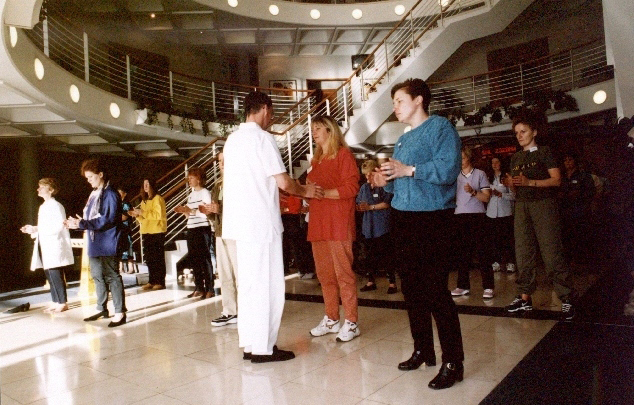
As your skills and Qigong continue to develop. You will find that the focus that you once had, for things like Wuji stance, are no longer necessary. There is an awareness of Wuji and you will be alert to any changes, any flaws that occur. Rather than focusing on getting correct, it will be correct. You will immediately notice when that changes. In a similar fashion, the movements that you use, those slight tensions to draw your awareness to particular meridians or particular points become less and less necessary because you understand where those points are. You understand those meridians. You understand and have experienced those feelings, those sensations. So the Yi guides the Qi. You will also find that you no longer need to focus on the breath to draw, or push, the Qi along meridians. Let’s get one thing clear here, that Qi is already in the meridian. It’s your awareness of it that’s being enhanced so that, with that awareness, you can enhance the quality of the Qi.
As your Qigong becomes more and more internal you require less and less physical stimulation. Now you can practice Passive Qigong. You can move the Qi along the same meridians, activating the same acupuncture points, but without the need to move the body physically. You have refined your skills to the level where the Yi and the Shen are all that are required. The great advantage here is that you can practice your Qigong while standing in a queue, sitting in a café, sitting in your car, etc. There is no longer than need to move the arms and the legs. Everything is done internally.
Does your current Qigong teacher have the answers?
Now you are practicing Qigong at a higher level. Here is my question to all of you. Pick any Qigong that you practice. Where is the Qi moving? Is that where it is supposed to be moving? Do you not know where it should be moving? Have you not been taught this? Do you have the right Qigong teacher?
Already practicing and interested in becoming a Qigong teacher?
At San Bao School we have a number of Qigong teacher training courses on offer . Historically, theses Qigong teacher training courses were held live, in person, here in Scotland. However, since Covid 19 prompted Des to add to his online courses by starting to teach (streamed) classes online it became apparent to him that some of the Qigong teacher training would also be possible online.
Keep an eye open for future courses: –
- Shibashi Instructor course – online Qigong teacher training.
- The Exceptional Vessels Instructor course – a mix of online Qigong teacher training with a live assessment.
- The Ba Duan Jin Instructor course – a mix of online Qigong teacher training with a choice of live, or online, assessment.
Hello Des,
Why does the Qi Gong that you are teaching differ from that qigong that that I have already been taught?
Why am I experiencing more when I practice your way?
Thanks
Al
Hello Al,
Is that Qi Gong and general, or are you asking about particular sets of Qigong?
Hello Des,
I was talking about particular sets of Qigong. The eight strands of Brocade and the Shibashi.
I always felt relaxed and content after Qigong. Now I am experiencing movement (Internal movement) that I cannot explain. Additionally. I am experiencing smells, colors, tastes, memories (I think that they are memories) and emotions.
Hello Al,
Firstly, I cannot comment on the way that these have been taught by any individual teachers. However, I can give an overall answer. Simply put. Most teachers aren’t teaching Qigong.
I often used the analogy of music when working with Qigong or explaining Qigong and it fits well here.
If you imagine learning to play the piano. You start off with one key, an individual note. Then you learn how to play chords. Then simple tunes. And then more complex music. The progression is the same within Qigong. You start with this simple and move towards the complex. Firstly, though, you need to access the keys.
Staying with that analogy. You’re sitting at a piano and the keyboard lid is down and locked. Those keys you need access to are hidden below the lid. Unless your teacher knows that they are there they cannot teach piano as they have never accessed the keys themselves. They need to have access to those keys and understand how the piano works. They cannot teach you how to play the piano. It is the same in Qigong. All Qigong works on the same basis. Moving Qi. Awareness of that movement. Enhancing that movement by using the feedback received. It doesn’t matter what set. At all works the same way.
So I and all of the other true Qigong teachers unlock and lift that lid for you.
The two sets that you mentioned are both very popular and they are taught, I use that term loosely, by thousands of teachers. In most cases they had been taught physically, with no access to the Qi, no real access. I’m going to pick one exercise from the Ba Duan Jin and ask some very, very, basic questions. So that you can figure out for yourself whether or not you understand what is happening. Or what is supposed to be happening?
• What stance are you using? Do you understand that stance and how important it is?
• When you “open the wings” how far are you opening them? Why are you opening them this far?
• When you turn your head to look down behind you what are you looking at? Is there a reason for this?
• What Qi are you working with? What Elements? What meridians? What Acupuncture points?
If you have been practicing the Ba Duan Jin for any length and none of this has been explain/taught then you have to ask why this is so. You might want to ask your teacher and give them the opportunity to give you the answers. You might want to find another teacher, one who can answer them.
The same can be said of any other Qigong, or Qigong sets. Have the Internal aspects been explained? Have you been taught the why and how?
Your second question was “Why am I experiencing more when I practice your way?” You are not practicing my way, you are practicing Qigong. It is as simple as that.
When you’re practicing Qigong, you’re working with different Elements, different meridians. Each of these meridians has emotions, colours, tastes, etc associated with it. These associations were not chosen at random. These are triggered by the Qi in the meridians. It was by using Listening Jing (being passively aware of the Qi) that these correspondences were discovered. The brain interprets Qi in different ways. For some of us it is colour. For some it can be taste or smell. Others experience the tangible flow of the Qi. For most it is a mixture of all of these but with one being the most dominant.
If you are practicing a Metal Qigong you will get a different response to that from an Earth Qigong, or a Fire Qigong, etc. So these emotions, memories, smells, tastes and Internal feelings that you’re getting will be from either the Element you are working with, or the effect that it is having on another element. That can be either through the Nurturing Cycle where, for example, Fire nurtures Earth. Or through the Controlling Cycle, where another example is of Fire controlling Metal.
Des