
Using Shu Points in Qigong
There are not many examples of sets using Shu Points in Qigong but I have listed a few of them here. Practicing, using Shu Points in Qigong is a very effective way of dealing with chronic, or historic, ailments. Please see the Shu Points post for their medicinal uses.
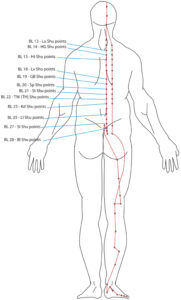
The Shu Points are all located 1.5 cun (Acupuncture inch) lateral to the mid-line of the spine.
Rowing a Boat in the Middle of the Lake
From the basic version of this Qigong, in the Taiji Shibashi, the main influence is on the Large Intestine Shu Point. This is located between the 4th & 5th lumbar vertebrae. It is accessed by keeping the legs in the Wuji position and not increasing the bend on them.
By altering the amount that the body lowers (through sinking the Qi) and by altering the overall shape of the spine (curling the back) you can target and stimulate any of the following Shu Points, but you have to be accurate and focused to do so.
- BL 13. Between the 3rd & 4th thoracic vertebra: Lung Shu point.
- BL 14. Between the 4th & 5th thoracic vertebra: Heart Governor Shu point.
- BL 15. Between the 5th & 6th thoracic vertebra: Heart Shu point.
- BL 16. Between the 6th & 7th thoracic vertebra: Governing Vessel Shu point.
- BL 17. Between the 7th & 8th thoracic vertebra: Diaphragm.
- BL 18. Between the 9th & 10th thoracic vertebra: Liver Shu point.
- BL 19. Between the 10th & 11th thoracic vertebra: Gall Bladder Shu point.
- BL 20. Between the 11th & 12th thoracic vertebra: Spleen Shu point.
- BL 21. Between the 12th thoracic and the 1st lumbar vertebrae: Stomach Shu point.
- BL 22. Between the 1st & 2nd lumbar vertebrae: Triple Heater Shu point.
- BL 23. Between the 2nd & 3rd lumbar vertebrae: Kidney Shu point.
- BL 25. Between the 4th & 5th lumbar vertebrae: Large Intestine Shu point.
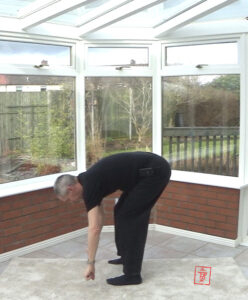
Rowing a Boat in the Middle of the Lake is an extremely versatile Qigong that can also be practiced in a seated posture to help access any of these Shu Points.
Hold the Feet to Strengthen the Kidneys
I will use this Qigong, from the Ba Duan Jin as the example. However, Hold the Toes and Strengthen the Kidneys, from the Ten Fundamental Treasures, also makes use of the Kidney Shu Points.
There is always more that one thing going on during a Qigong. With this one I will only be highlighting when the Shu Points are stimulated. This Qigong, although named “Hold the Feet to Strengthen the Kidneys” also uses the Yang partner of Kidney meridian, Bladder meridian.
After the hands have been swung out to the sides, raised above head height and the the palms turned to face each other, they are lowered (palms facing down) and finally being turned outwards. Move the hands around to the back so that the backs of the hands are facing the lower back. It is now that we focus on the Qigong using Shu Points.
Placing the backs of the hands so that they are over the Kidney Shu Points and Mingmen (the Gate of Vitality), your focus is on these points. Then, turning the palms in (to cover Mingmen), that focus is increased. Then that focus changes as you move down along Bladder meridian to BL 67.
Please note that I have not covered all the Internal movement that is involved in this exercise.
Kidney
There are a number of Qigong that were developed to use and enhance the connection between Mingmen, the Kidney Shu Points and Kidney meridian. One of these is the Kidney (meridian) exercise from the Five Taoist Yin where the Qi is circulated from the Shu Points and down Kidney meridian in one leg, then back up Kidney meridian in the other leg, finishing at the Shu Points.
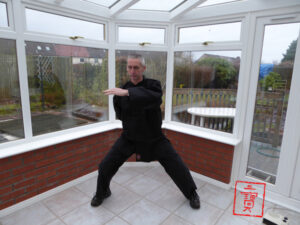
All Qi is connected but some of these connections can be enhanced, through Qigong, for beneficial purposes. That is why Qigong is so powerful…………… But qigong (faux) is not! The difference is this……………….
It is Qigong if you are practicing Internally and connecting your mind (the Yi) to the Qi while guiding it through focus and willpower. If you are doing that you are half way there. The other half is listening to the effect that guidance is having, having tangible awareness of its qualities.
It is (faux) qigong if you are only moving physically with no real understanding of what these exercises are. Moving your limbs while wishful thinking is not enough.
Find the right teacher, one who practices Internally and who can impart their knowledge and experience.