
The origins of Qigong – The Silk Exercises
I am often asked the question what are the Silk Exercises and how do they fit in with Qigong? Well, Qigong had to start somewhere and it started as physical exercises. It was during meditation after these exercises that people started to understand that there was more happening. There was more than just the physical stimulation. They started to feel other movements within their body that were not connected directly to the physical movements that they were doing. These simple physical exercises gradually, very gradually, developed to work with the Internal, into what is now termed Dao Yin, Neigong, Qigong, etc.
By having and building that awareness of the Qi, they started to notice that there were definite patterns. There were definite qualities and these qualities, when followed, when tracked through the body, became what we now know of as the meridians.
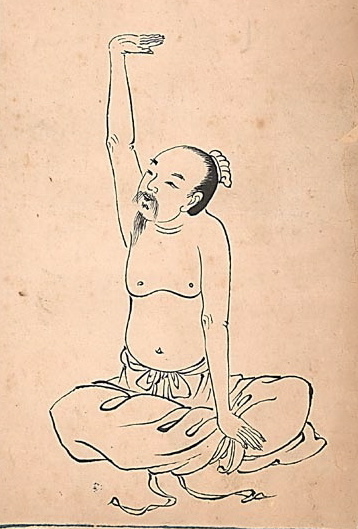
These simple lines that are drawn on diagrams of the body, these abstract lines are not meridians. The meridians are energy fields where that underlying quality is present. It was by following that quality that the ancient masters mapped out what we now know of as the meridian system. All of these energies are connected. They are all made of Qi except that they all have their own individual qualities. These qualities have been bracketed into what we call the Five Elements of Fire, Earth, Metal, Water and Wood.
The origins of Qigong – Standing in others’ shoes
For experienced practitioners it’s quite difficult to regress back into just working physically. But it really makes a difference to your Qigong if you manage to step into the shoes of those ancients and to work through these physical exercises, listening to the changes as they occur, reliving the origins of Qigong. This alone makes these exercises worthwhile and it helps any and I mean any Qigong practitioner to enhance their own abilities.
In its infancy, it was all about gaining an overall awareness. Then as the understanding grew, as their experience of Qi grew, they began the long task of refinement. It was by listening to the Qi, by analysing what they were experiencing and by taking note of what actual movements were triggering these changes that the art of Qigong was born. It’s through this work by the Masters, through generations of Masters, that we now have Qigong that is very efficient (but only when practiced Internally as true Qigong). That efficiency means that practitioners can accurately work with many levels of Qigong. Be that health and wellbeing, martial, or spiritual.
The origins of Qigong – moving from the external to the Internal
As stated, Qigong started off as physical exercises. Unfortunately, many people who practice what they think of as Qigong nowadays have only been taught physical exercises. They are not practicing Qigong and so will only gain what physical benefits these physical exercises bring. They are not working Internally, working with Qi, and will never realise the true potential of Qigong.
If you are a Qigong practitioner who practices Internally, then it will be very, very strange to step back into the realm of physical exercise. It’s difficult yet exhilarating to step into the shoes of the Masters who developed these exercises. But we have an advantage. We have already been working with Qigong. We have already been working Internally. We know what to expect. We are aware of meridians.
The vast majority of Qigong practiced nowadays is practiced in Wuji stance, Horse Riding stance, or a Front Stances, also known as a Bow Stance. In the Silk Exercises we are making use of what is known as the Attention Posture. That is standing with the ankles almost touching and the toes pointing out to the diagonal. Standing in this posture means that, even without any knowledge of the Hip Kua, when you are moving from side to side, when you are shifting your weight, the position of the feet makes sure that the Hip Kua are being used. This brings awareness of the Qi movement here, even when standing still. The Horse Riding stance also makes use of this toes pointing to the diagonal position.
The origins of Qigong – Where we are now
Any of you who are familiar with, who practice the Ba Duan Jin, or the Ten Fundamental Treasures will recognize the names and, partly, some of the movements of these exercises. In, for example, the Ba Duan Jin there is an exercise called Holding up a Single hand. In the Ten Fundamental Treasures it is called Harmonizing Stomach and Spleen. In the Silk Exercises it is known as the Single Arm Lift. The first two and many others can trace their ancestry back to the Single Arm Lift of the Silk Exercises. This is the same for many Qigong.
The origins of Qigong – Step by step progression
The Silk Exercises are from right at the origins of Qigong and there are four sets. The first three are practiced in the Attention Posture. The fourth set is practiced in the seated posture. When you practice all four sets, when you work your way through the sets, you begin to understand how the development progressed. Gradually from, in the first set, exercises where you can be aware of the Qi, or you are aware of the Qi, but it isn’t focused, it is a general awareness. Then this awareness increases as the physicality of the exercise is decreased. Its increases when you stop overstretching with the physical body, relax more into the movement and pay attention to the Internal.
You can really see that during the origins of Qigong there was a lot of experimentation going on with these exercises. It is not a linear progression. When you look at some of the moves in set number three as opposed to set number one You can see that we are working with completely different qualities of Qi. When these exercises were first practiced there was no concept of meridians. It was through continuous, diligent practice that the health benefits started to be understood and the qualities mapped out In such a way that we now have the 12 Classical Meridians as well as the Eight Extraordinary Meridians. It was through the noting of the health benefits that a link was make to the exercises practiced and the quality of the Qi being stimulated.
An example of this progression from the origins of Qigong
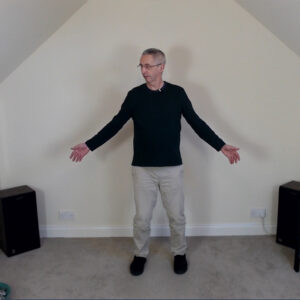
In the silk exercises, we have an exercise called Looking Backward. This developed into what we now know as the Wise Owl Looks Backwards (in the Ba Duan Jin). In the first set of the silk exercises this is a stretch. You are turning the head from side to side and stretching the muscles in the front of the neck and the back of the neck. Through practice and through relaxing more into the movement rather than overly stretching you start to understand, start to notice that the Qi is being affected in the front of the neck and at the back of the neck. Effectively working with Stomach meridian and also with Gall bladder meridian.
In the second set, the movement changes slightly. What happens here is that you are no longer working with Stomach meridian. You are only working with Gallbladder meridian at the back of the neck.
In the third set, you are still looking backward, but you are not doing it by turning the neck. You are using the entire body. Once again, you are working with Gallbladder meridian but you are also having an effect on Liver meridian and Spleen meridian.
In the fourth set the exercise is called Hugging the Head and it too is working with Gallbladder meridian.
When we move forward many generations we have The Wise Owl Looks Backward (Ba Duan Jin) where the Qigong is using the Controlling Cycle of the Five Elements, using Metal to control Wood.
Another branch led to the Ten Fundamental Treasures where there are two methods of practicing this Qigong. One working with Metal (Lung meridian) and the other working with Wood (Gallbladder meridian).
There are also other branches where the physical movements (or very similar) of these exercises have been adjusted to create other Internal uses.
If you wish to understand the origins of Qigong and experience the development, the archived videos of the classes can be found here – the Silk Exercises lessons.