Qigong Techniques – Using Tonification and Dispersal
Tonification and Dispersal is a simple way of applying these Qigong techniques to create energetic change within the human energy field.
Traditionally, the terms Yin and Yang have been used to describe these states but this very often leads to confusion and misunderstanding. Yin and Yang only exist in relation to each other so you could have two depleted acupuncture points, one more so than the other. Using the Yin Yang model the more depleted point would be Yin in relation to the less depleted point. Yet both are Yin and require tonification.
With that in mind, I will be using the terms “congested” and “depleted” to identify where the Qi needs to be moved from and wher it should be moved to.
TONIFICATION – The process of guiding Qi to a depleted meridian, point, or body area.
DISPERSAL – The stimulation of Qi in a meridian, a point, or an area of the body where it is congested.
This description is still largely prevalent, as is the belief that Qi moves to the depleted area, flowing river-like, through the meridians. However, a better analogy is that of a modern transportation infrastructure, or an internet infrastructure, where there are many routes open between A and B and the Qi makes use of all of these.
My experience and that of many of my students has revealed this traditional view of the movement of Qi to be simplified and somewhat inaccurate. Although up to a certain level of expertise, this particular view does have a purpose.
Whether you are happier using the more the more traditional view, or are comfortable with the interconnected web view, the method is the same. You need to prepare the Qi to be moved from the congested before it will flow to the depleted.
The Traditional view of healing using these Qigong techniques, briefly, is as follows: –
TONIFICATION
Depleted
Covert
Passive
Slow response
Methods used:
Single point
Longer focus
Patience
DISPERSAL
Congested
Overt
Active / Responsive
Fast response
Methods used:
Chapping / Rubbing
Stretching / Swinging
Rotations
Often, it is forgotten that there is a dynamic connection between the depleted and the congested, and descriptions of tonification and dispersal often imply that each is a separate condition to be treated as such. The fact is that the depleted (Yin, or Kyo) and the congested (Yang, or Jitsu) together are the result of a particular energetic condition.
The most successful energetic changes are achieved when the dynamics of depleted and congested are taken into consideration and both are involved in any particular creation of energetic change.
When you consider how energy moves, expansion /contraction, etc. and what creates the formation of depleted and congested you realise that neither should be considered in isolation.
Qigong Techniques – Dispersal , dealing with the congested
There are a number of Qigong techniques where (in Active Qigong) quicker, sometimes jerky, movements are utilised. However, this preparation for dispersal and movement is part of the Daoyin (Qigong) preparation exercises where we use: –
- Quick stimulation of various points.
- Joint rotations (neck, shoulders, etc.).
- Chapping of the meridians.
- Arm swinging (powered by the use of the stance and the Kua).
- Opening the Kua (energy gates).
- Gentle stretching.
In many Qigong we make use of these gentle stretches to access a particular meridian in order to prepare (loosen, break up, dissolve) the Qi in a meridian while, during the same Qigong, we focus that Qi on a different meridian. I will give an example of this later.
In the terms of dispersal technique the response may not be immediate unless the dynamics of change are on the right frequency and overall quality change takes place within the energetic structure. Another reason for lack of change is if the practice has remained merely on a physical level.
Through practice, the general application of technique as outlined becomes more ‘user friendly’, and more effective.
Qigong Techniques – Tonification
Tonification of very depleted acupuncture points occasionally requires that you focus to the deepest level and wait some time for the response. If this fails to achieve the movement of Qi to any particular Acupuncture point you will need to spend more time preparing the congested Qi (points, or meridians) for movement.
Generally in the case of tonification, response is immediate if the point is going to respond at all so you will quickly know if further dispersal is required. However, before going back to any dispersal, continue working along the meridian as, very often, a point further along can trigger the necessary response.
Mobilisation of the congested in conjunction with focus on the depleted point(s) utilises the dynamic connection between depleted and congested and, whatever the energetic change which takes place, it will occur where ever it is most needed and will not necessarily ‘fill up’ the depleted point that is being focused on.
The Wise Owl Looks Backwards (Ba Duan Jin)
This is an example of an exercise that uses the Qigong Techniques of dispersal and tonification. It is especially effective with a chronic imbalance between Metal and Wood.
When practiced properly, the Wise Owl starts the process of dissolving congested Qi in Gallbladder meridian (and therefore its Yin partner, Liver meridian) through the correct action of the head turns. It starts this process at Gallbladder 12 and Gallbladder 20.
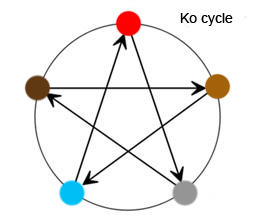
When proper focus is then placed on Lung meridian (Lung 1 and Lung 11) and Large Intestine meridian you are using the Ko Cycle to “rein in” Wood while increasing the power of Metal to achieve and maintain balance between the two Elements.
Without the knowledge of the Internal focus and movement of any Qigong you will never experience its true potential. You will not know what it is capable of, or what its uses are. Always question your teacher about these and if they do not have any answers………. find another teacher.
Qigong Techniques – Some handy tips
New, acute, conditions – Usually make themselves apparent in the Mu points (front of the torso. If acted on promptly they have a tendency to clear relatively quickly.
Long standing conditions – Usually show up in the Shu points (either side of the spine) and take longer to shift. Use the Ko Cycle (Controlling Cycle) for chronic conditions. Short sessions of Qigong are best as your focus will be sharper. Practicing at a physical level will not achieve the desired results and can actually deplete your energy.
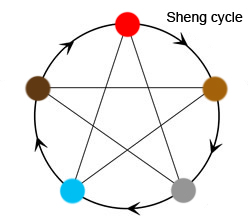
Low energy – Use the Sheng Cycle (Nurturing Cycle) finishing with the Element that is most depleted. Do not try to do everything at once, go for small but continuous progress.